PART II (OF V)
HISTORY
Vasco da Gama Regatta Club
By Wikipédia and Julio
.
| Vasco da Gama | |
 | |
| Nome | Club de Regatas Vasco da Gama |
| Alcunhas | Gigante da Colina[1] Time da Virada[2] |
| Torcedor(a)/Adepto(a) | Vascaíno cruzmaltino |
| Mascote | Almirante Bacalhau Dom Corvo I e Único |
| Principal rival | Botafogo Flamengo Fluminense |
| Fundação | 21 de agosto de 1898 (128 anos) |
| Estádio | São Januário |
| Capacidade | 21 880[3] |
| Localização | Bairro Vasco da Gama, Rio de Janeiro, Brasil |
| Mando de jogo em | São Januário Maracanã[4] |
| Capacidade (mando) | Maracanã: 78 838[5] |
| Proprietário(a) | SAF:[6] CRVG (69%) 777 Partners (31%) |
| Presidente | Pedrinho[7] |
| Treinador(a) | Pedro Emanuel[8] |
| Material (d)esportivo | Nike[9] |
| Competição | Cariocão – Série A[10] Brasileirão – Série A[10] Copa do Brasil[10] Copa Sul-Americana[10] |
| Ranking nacional | 8.º lugar, com 20 330 pontos[11] |
| Website | vasco.com.br crvascodagama.com |
     Uniforme Uniformetitular      Uniforme Uniformealternativo | |
The Club de Regatas Vasco da Gama is a Brazilian socio-multi-sport entity based in the city of Rio de Janeiro, founded on August 21, 1898 by a group of rowers, inspired by the celebrations of the fourth centenary of the expedition that established the first direct maritime route between Europe and India, led by the Portuguese navigator Vasco da Gama. Although it originated in regattas, the club started to operate in various sports, such as athletics, basketball, beach soccer and American football, with soccer as its main modality. In addition, it is the Brazilian club whose athletes have won the highest number of medals in Olympic and Paralympic Games.
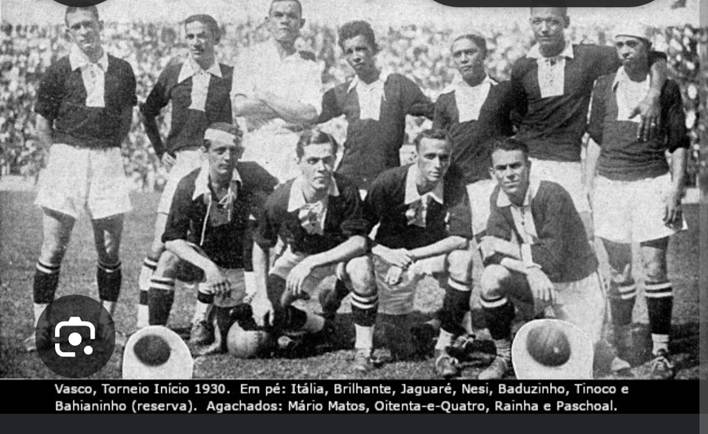
One of its first titles was the 1923 Campeonato Carioca, won by the team known as Camisas Negras, composed mostly of black and working-class players. [12] The episode most associated with the club’s position in relation to racism was the so-called Historical Response, a letter in which Vasco da Gama refused to dismiss twelve of its black athletes, contrary to the determination of the Metropolitan Association of Athletic Sports (AMEA), then the league responsible for Rio de Janeiro football, which claimed that they were people with a “dubious profession”.
In terms of titles, Vasco da Gama won the Rivadávia Corrêa Meyer Octagonal Tournament, successor to the Copa Rio, and the 1957 Paris Tournament, in a final against Real Madrid, in, according to FIFA, the largest meeting between teams from two continents before 1960. At the continental level, he won the South American Championship of Champions, the 1998 Copa Libertadores, in the year of his centenary, and the 2000 Copa Mercosur, whose final is known as the “Turn of the Century“. At the national level, it has won four Brazilian Championships, one Copa do Brasil, four official interstate titles and several state titles, including Carioca Championships and tournaments such as Municipal, Extra, Início and Relâmpago. Throughout its history, it has also won other national and international tournaments in football.
On the other hand, Vasco has four relegations to the second national division, and is also going through the longest period without conquests in its history, with the last official title being the 2016 Carioca Championship. [13] In addition, it accumulates one of the largest debts in Brazilian football, estimated at values above one billion reais, which triggered a request for judicial recovery. [14] The unfavorable financial situation had already led the club to sell 70% of the shares of the football joint-stock company to investor 777 Partners, in 2022,[15] whose stake was later reduced due to a global financial collapse of its companies. [16]
History
Main article: History of the Club de Regatas Vasco da Gama
1898–1915: Founding
The Club de Regatas Vasco da Gama was founded as a rowing club on August 21, 1898 by a group of 62 young Portuguese immigrants and Portuguese-descendants, gathered in the neighborhood of Saúde, in Rio de Janeiro. [17][18] The name was chosen in reference to the commemorations of the four hundredth anniversary of the voyage of the homonymous admiral to India, celebrated that year. [17][19] Already affiliated with the União de Regatas Fluminense, the club debuted in official competitions in Botafogo cove, on June 4, 1899. On that occasion, the six-oared whaler Volúvel won the first race in the junior category, winning Vasco’s first victory in rowing. [20]
On November 24, 1905, Vasco won its first Carioca Rowing Championship, in a competition that was attended by the President of the Republic Rodrigues Alves among the spectators. [17] The following year, it was crowned two-time state champion. [21] Until 2012, the club had won the championship on 46 occasions. [20]
On 26 November 1915 Lusitania Sport Club was incorporated into Vasco, giving rise to the club’s football department, despite opposition from the associated rowers. [17] Cruzmaltino played its first official match on 3 May 1916, in the third division of the Liga Metropolitana de Sports Athleticos (LMSA), being defeated 10–1 by Paladino Foot-Ball Club. [22]
1922–1934: Blackshirts and the fight against racism
Since that time, the club has incorporated athletes from different ethnic and social backgrounds into its ranks. [23] In 1922, it won its first state Serie B title, which guaranteed it access to the first division of the Metropolitan League of Terrestrial Sports (LMDT). [24] The Vasco squad was quite diverse, with blacks, browns, Portuguese, and poor working-class whites. [17][25] Although there were other clubs with players of these characteristics, this was the first time that teams with greater financial power in the city faced an equivalent team from the periphery. [17][26]
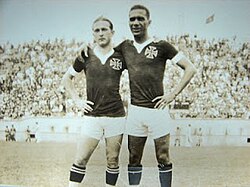
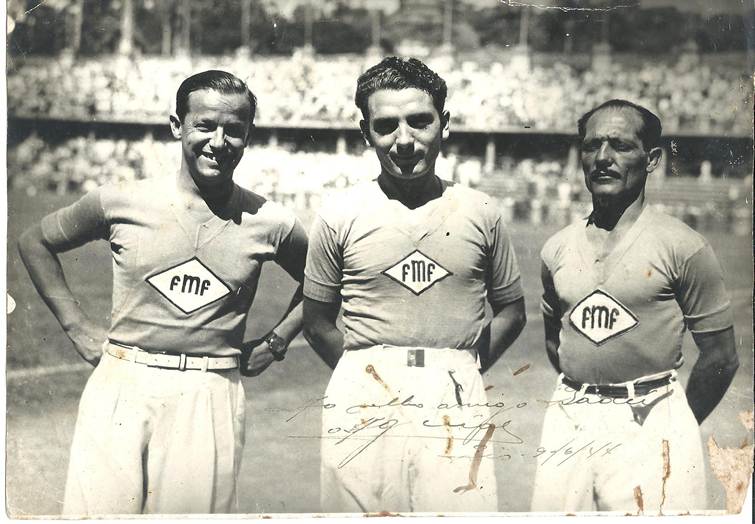
Itália and Fausto, Cruzmaltino highlights during the 1920s and 1930s.
In 1923, Vasco won, in its debut year, the first title of the elite of the Carioca Championship. [12] However, in 1924 the clubs of the South Zone (the most prestigious socioeconomic area of Rio de Janeiro) united, left the LMDT and founded the Metropolitan Association of Athletic Sports (AMEA). [27] Vasco could only join the new entity if it dismissed twelve of its athletes, all black, on the grounds that they exercised “dubious profession”. [26][25] Faced with the demand, the president of Cruzmaltino José Augusto Prestes sent a letter to AMEA refusing to accept the imposed condition and giving up membership. [25] The document, known as the “Historical Response“, is considered a milestone in the discussion about racism in Brazilian football. [28][25]
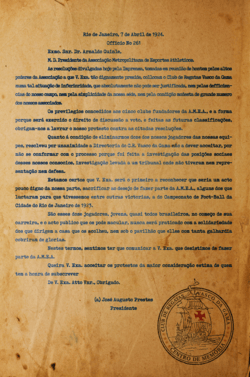
Letter from the president of Vasco da Gama to the Metropolitan Association of Athletic Sports, refusing to dismiss twelve black players and giving up membership in the association, known as the Historical Response.

Wikisource contains primary sources related to Historical Response
Thus, in 1924 two championships were played in parallel,[26][27] and the LMDT championship was won undefeated by Vasco. [26] The following year, due to attracting the largest audiences and revenues,[29] the club overcame the resistance of the AMEA and joined the entity, under the condition of playing its matches at the Andarahy field. [30]
Despite this, Vasco decided to build its own stadium in order to eliminate any requirements imposed by the AMEA. [25] The site chosen for the construction was the Chácara de São Januário, property that had been granted by the former emperor Dom Pedro I to the Marchioness of Santos. [31] On 21 April 1927 the club inaugurated the Vasco da Gama Stadium, widely known as São Januário, then the largest sports venue in the Americas. [32]
In 1929 Vasco won the third Campeonato Carioca in seven years in the first division. [33] In 1931, it became the second Brazilian club to be invited to an international tour, after Paulistano, and the first to win the Myrurgia Cup, against Barcelona. In the same year they defeated Flamengo 7–0, a result that remains the biggest rout in the history of the Classic of the Millions. [34] In 1934 he won the Campeonato Carioca again, with a squad that included players such as Leônidas da Silva, Domingos da Guia, Russinho and Fausto. [35]
In 2023, the Chamber of Deputies approved a bill that included the Blackshirts, the name by which the cast of that period became known, in the Book of Heroes of the Fatherland. [36]
By Jucele
Julio Leal
Coach, U-20 World Champion in Australia in 1993 and two-time South American Champion
September 6, 2026
P.S. – Yesterday, September 5, I went to the Island to celebrate the birthdays of some friends with over 60 years of friendship. Wonderful! Lots of stories and laughs! Churrasquinho da Ribeira, very good barbecue, impeccable service from the Didi Family!
By Jucele
Julio Leal
Treinador Campeão Mundial Sub 20 na Austrália em 1993 e Bicampeão Sulamericano
06 de setembro de 2026
P.S. – Ontem, 05 de setembro fui à Ilha comemorar niver de alguns Amigos de mais de 60 anos de Amizade. Maravilha! Muita resenha e risadas! Churrasquinho da Ribeira, churrasquinho muito bom, atendimento da Família Didi impecável!


.png)