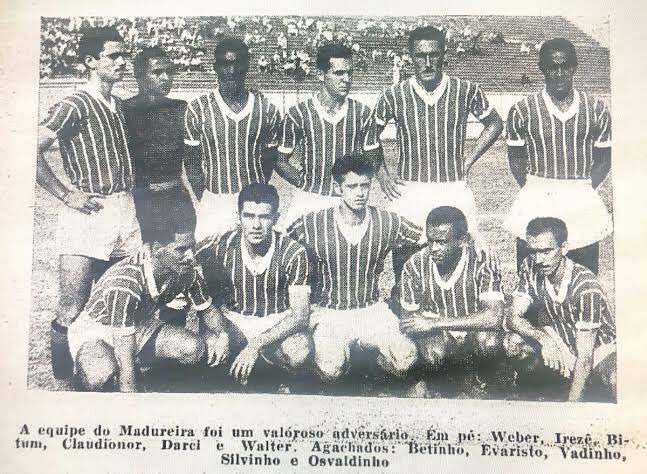
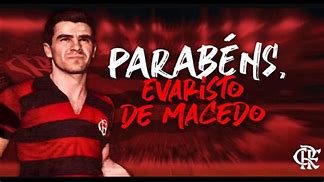
Evaristo de Macedo Filho or simply Evaristo de Macedo (born June 22, 1933 in Rio de Janeiro), is a former Brazilian football manager and striker.
He is, to this day, the only player to make a “Manita” (that is, to score 5 goals in the same match) with the shirt of the Brazilian National Team. This occurred in 1957, in the South American Championship that year, when Brazil thrashed Colombia 9-0.
Evaristo de Macedo played for Madureira, Flamengo, Barcelona and Real Madrid, being one of the best Brazilian players of all time, also consecrated as one of the most laureate coaches of Brazilian football. He has lived in Rio de Janeiro since retiring from football in 2007.
Career
Born on June 22, 1933 in the capital of Rio de Janeiro, Evaristo woke up to football while still at the Granbery Methodist Institute in Juiz de Fora, Minas Gerais. [1] At the age of 17 he began his professional playing career at Madureira in 1950. Two years later, he was already at Flamengo, where he was a three-time Rio de Janeiro champion in 1953, 1954 and 1955 under the command of Paraguayan master Fleitas Solich.
He graduated in Physical Education from the Federal University of Guanabara.
Barcelona and Real Madrid
Evaristo de Macedo achieved the feat of becoming the idol of two rivals in Spain: Barcelona, a club he played for from 1957 to 1962, and Real Madrid, where he played between 1963 and 1965.
With Barca, Evaristo won several titles, among them the Spanish championships of 1959 and 1960 and the UEFA Cups of 1958 and 1960 . In addition, the former striker, who had as one of his main virtues the skill, was the greatest Brazilian scorer in the history of the Catalan club.
For the merengue team, Evaristo went on to win titles. There were three Spanish championships: 1963, 1964 and 1965, being until today the greatest Brazilian goalscorer in Barcelona (adding official and friendly matches).
Still in 1965, despite proposals from Europe and Brazilian teams, he returned to Brazilian football and ended his career at Flamengo, where he scored 103 goals in 191 matches in the two passages.
“The Brazilian fan has no idea how Evaristo de Macedo is idolized in Spain. He was undoubtedly one of the greatest players in the world of all time,” says Roberto Dinamite, a former Vascaíno idol who had a brief spell at Barça.
“It’s a political rivalry, I’ve never had any doubt about that. It is the game between the “State of Catalonia” and the “State of Castile”, something that transcends the sporting sphere. The Catalans are very resentful of the loss of freedom they had in Francoism, the Civil War… so it was always a climate that went beyond the other sporting rivalries I’ve experienced.” [2]
Brazilian National Team
He competed at the Helsink-Finland Olympics in 1952 while playing for Madureira.
For the Brazilian national team, Evaristo de Macedo did not have many chances to play. He played in only 14 matches, but left his mark of great goalscorer: scoring eight goals.
A star of Flamengo in 1957, Evaristo was a candidate to be one of the 22 players called up for the 1958 World Cup in Sweden. He was part of the national team’s offensive quartet until April 1957, when a transfer totally changed history. “I was sold at the age of 24 to Barcelona and never wore the shirt of the Brazilian National Team again. A pity, a pity…” [3]
In Catalonia, he received a phone call on the eve of the final squad for the 1958 World Cup. “It was the technical coordinator Carlos Nascimento. He told me: ‘Evaristo, we are going to start training for the World Cup and the coaching staff wants you to ask Barcelona for your release.’ I tried, but the club didn’t release me. Spain had not qualified for the World Cup in Sweden and the clubs there decided to keep the National Championship normally, without giving up anyone.” [3]
When he informed the former Brazilian Sports Confederation (CBD) of Barça’s denial, Evaristo noticed Nascimento’s sadness: “Gee, boy, what a pity! Vicente Feola (coach) was looking forward to seeing him play alongside a good little bit of the ball that came up there at Santos.” [3]
Evaristo was curious, but the lack of technology prevented him from snooping on the lives of others. “If it was today, I’d definitely turn on cable or go online quickly to find out who he was talking about. But back then I had none of that, mate! I continued my little life there in Barcelona, on the other side of the Atlantic, not knowing who was the neguinho called Pelé“, amuses the greatest Brazilian scorer in the history of the Catalan club, with 78 goals in 114 matches.
Evaristo did not see Pelé emerge in the national team for a matter of months. His last match with hopscotch was against Peru, on April 21, 1957, at the Maracanã, for the World Cup Qualifiers. Exactly 77 days later (two games), the boy came off the bench to replace Del Vecchio and score the only green-yellow goal in the 2-1 loss to Argentina, at the same Maracanã, for the Copa Roca.
While Brazil saw the birth of a king, Evaristo painted and embroidered in Spain, alongside other stars. “In my spells at Barcelona and Real Madrid, I played alongside Puskas, Kocsis, Czibor, Gento and Di Stéfano. They were all stars, but none like Pelé, who I met live playing against him in 1959.”
“I knew he existed in 1957, but I only saw him in the flesh when Santos made a tour of Europe and beat Barcelona 5-1. That day, I met the sharpest attacking duo I’ve ever seen play: Coutinho and Pelé.”
In the Brazilian National Team, Evaristo set a record. He was the only player to score 5 goals in a single match for the national team.
Evaristo began his coaching career at America in 1967, where he was champion of the Negrão de Lima International Tournament, from where he left for Fluminense in 1968.
Style
According to ‘Old Wolf’ Zagallo, who played alongside Evaristo at Flamengo, “Evaristo was the type of player who had a place in any team he chose.” And, revealed by Madureira, the player chose to defend only Flamengo in Brazil. He spent five years at Gávea, from 1952 to 1957, which was enough to become one of the great idols in the history of the club.
In addition to winning over the female fans for his beauty, Evaristo stood out on the field for his speed, vision of the game, intelligence in creating plays, and great technical ability. At the age of 19, he was called up to the Brazilian National Team that competed in the Helsinki Olympics in 1952, when he was still playing for the youth team of Madureira. The following year, he began his victorious career at Fla.
Trainer
As a coach, he directed other important teams of Brazilian football. Some of them were: Flamengo, Fluminense, Vasco da Gama, Bangu, Bahia, Grêmio, Corinthians, Santa Cruz, Vitória , Atlético Paranaense and Cruzeiro.
In Qatar, he led the junior and senior national teams, leading the country to two Olympics and becoming the 1981 junior world runner-up at the World Cup in Australia.
In 1977, he was the coach of the Brazilian Junior National Team, third place in the World Cup in Tunisia.
As coach of the main Brazilian National Team, Evaristo de Macedo directed the team in 1985, shortly before the 1986 World Cup Qualifiers in Mexico, leading the Brazilian team to that tournament, but was eventually replaced in the position by Telê Santana. He coached Iraq at the 1986 World Cup.
However, three years later, he lived his best moment as a coach and was Brazilian champion of 1988 directing the team of Bahia. He directed the team that was Brazilian champion. The base team of the Bahian Tricolor had: Ronaldo; Tarantini, João Marcelo, Claudir and Paulo Róbson; Paulo Rodrigues, Gil, Bobô and Zé Carlos; Charles and Marquinhos.
At Grêmio, he won the 1997 Copa do Brasil, precisely over Flamengo, the club he defended as a player. Grêmio’s base team was: Danrlei; Arce, Rivarola, Mauro Galvão, Roger; Dinho, Emerson, João Antônio, Carlos Miguel; Dauri and Paulo Nunes.
P.S. : Copied in part from Wikipedia.
P.S.: There should be a bust of you, or even a statue in every club you went through.
P.S.: Happy are those who worked with him, I met some like Ronald Carvalho, Pioneiro do Fundão, Emeritus connoisseur of Football, one of his best Friends and among all, the one who knows him best; Francisco Gonzales (great Physical Trainer in Brazil and abroad) and Carlos Alberto da Luz (D.E.P.) who tell amazed of their ability, the cases lived, the achievements, the stories, which became Stories and Legends.
P.S.: Will turn 90 years soon, I humbly wish you to have health and long life, to be able to continue to tell your stories, experiences and teachings to the youngest,
Me and Beto, from Entremicros, a giant human being, too, plus his other clients spent hours drunk listening to him parade cases and causos around the world. The Computer Store stopped, literally!
P.S.: In Official Games I faced him only once when he was managing Vitória, in Barradão. In the other, a Training Game in Gávea, when I directed the Junior of Flamengo and Evaristo with Ronaldo, Da Luz and Brilhante (Shinning)C.T. directed the Qatar Junior Team that won, the World Category (unless mistaken)
May God bless you and keep you, take care also of your dear Family.

 Julio Cesar Leal
Valeu.
CurtirCurtir
Mudou o tempo…. mas o Sol já saiu um pouco, vou correr… beijo
CurtirCurtir