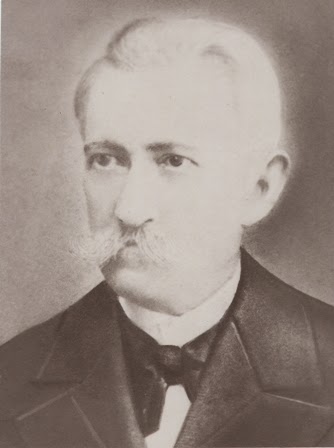
Júlio Cesar Leal
Son of Ezequiel Leal and D. Alexandrina Leal, he was born in Bahia on February 6, 1837, disincarnating in Rio de Janeiro, on November 22, 1897, victim of a malarial fever that he had contracted in the city of Macaé, where he held the position of Customs inspector. A distinguished and zealous employee of this department of the Treasury, he had served in several states of Brazil and had participated in different commissions.
Journalist, poet, novelist, playwright and vigorous polemicist, he was one of the oldest pioneers of Spiritism in the country. Referring to the talented Bahian, Sacramento Blake, wrote in volume V of his “Brazilian Bibliographic Dictionary”: “Robust talent, fervent dedication to office work, skillful and well-trimmed pen, he had occupied himself not only with literature in all its branches, but also with philosophy, religion, politics, national history, legislation and commerce”.
As a Spiritist, he was, in fact, one of the first in Brazilian territory, and his conversion took place in the capital of Bahia. He and four other friends were gathered in a room of a certain Masonic Lodge in Salvador, when the conversation in which they were entertaining themselves turned to Spiritism. The works of Allan Kardec, in French, began to appear in that “loyal and valiant” city, already giving something to talk about in the most cultured circles. At a certain point, the group agreed to do an experiment: they would put paper and pencil inside a glass sleeve that was on a table, in the room opposite the room where they were talking. Then they would close the door of the room and, concentrated, asked for the help of the good spirits, so that one of them would provide them with proof of an afterlife. So they did. After fifteen minutes, they heard the door knock from the inside: they opened it and, astonished, found a written and signed message. This fact was enough to lead them to the study of Spiritism, and behold, Júlio Cesar Leal became, in a short time, an enthusiastic propagandist of the Spiritist Doctrine, soon appearing in him the mediumship of incorporation: in a somnambulistic state, he transmitted, orally, beautiful and enlightening messages of high Spirits.
In 1869, he launched to the public, in Penedo (Alagoas), the first work in verse for the Diffusion of the Spiritist Doctrine in Brazil. It was entitled: “Spiritism – Poetic Meditations on the Invisible World, accompanied by an evocation”, with a preface dated November 18, 1869.
Júlio Cesar Leal graduated in Law and was a professor of humanities, we don’t know where or for how long. Well respected for his culture and erudition, he left in several Brazilian cities, brought to them by his functions as customs inspector, a well-liked name and precious intellectual collaboration, since he had been a writer of great inspiration and a speaker of great flights. His word was easy and sometimes eloquent, always using these gifts to serve the Spiritist Doctrine.
He dedicated himself to journalism with high public spirit, and this is how he wrote the “Jornal de Penedo”, of which he was the founder in 1871, the “Jornal de Alagoas”, a political and news organ in Maceió, the “Jornal do Comércio” and the “Gazeta de Notícias”, both in Porto Alegre, the “Jornal do Povo”, in Bahia, etc.
An illustrious playwright, he wrote eight dramatic plays, and as he predicted – as Pedro Calmon declares in his “History of Bahian Literature” – the war of Canudos in his drama “Antonio Maciel, the Counselor” (1.858). He became a member of the Dramatic Conservatory of Bahia, installed in the city of Salvador, in 1857, by Dr. Agrário de Souza Menezes.
Passing through Rio de Janeiro, in 1881, the Academic Society of God, Christ and Charity enrolled him in its membership and he gave on April 12 and 19, at the Public School of Glória, two conferences on the theme – “Materialism and Spiritism”. The lay press gave extensive news about these conferences, applauding the ideas expressed by the eloquent speaker.
On July 6, 1881, he founded, in the city of Recife, the weekly Spiritist – “A Cruz”, the first organ of Spiritism in Pernambuco. It was a four-page newspaper, printed by Tip. Universal, at Rua do Imperador, no. 50. Unfortunately, its duration was short, given the insurmountable obstacles that faced it.
Living in Rio de Janeiro, Júlio Cesar Leal belonged to the Assistance to the Needy of the Brazilian Spiritist Federation, which then operated at Rua da Alfândega, n.º 342, 2nd floor, developing, together with other selfless companions, extensive services of help and sick of body and soul.
In the first seven months of 1895, he presided over the Brazilian Spiritist Federation, in a period of serious internal crisis that could only be overcome when, with his resignation (J. C. Leal), Dr. Bezerra de Menezes assumed, on August 3, 1895, the direction of that House. Bezerra sought, from the outset, to bring together the dispersed forces, emphasizing the need for an organized Spiritist movement, with unity of leadership, and also demonstrating that the Federation fulfilled all the conditions to be the center of the union of Brazilian Spiritists.
As for Júlio Cesar Leal, he did not finish his mission in that House, tireless worker that he was. He continued to contribute with the best of his efforts so that the propaganda work continued actively and incessantly, launching new books for publicity and giving Spiritist lectures in various Societies. He became one of the effective directors of the “Center of the Spiritist Union of Propaganda in Brazil”, reinstalled, in a new phase, in 1894, working there alongside Bezerra de Menezes, Augusto Elias da Silva, Ernesto dos Santos Silva, Pinheiro Guedes and other Spiritists of projection.
This Center, whose meetings were initially held within the House of Ismael itself, and from which Bezerra de Menezes would leave in 1896, went into frank decline in the last quarter of 1897, for failing in its objective principles, leading other directors, including those mentioned, to leave it.
Júlio Cesar Leal was a speaker at public conferences at the Brazilian Spiritist Federation, sometimes collaborating in the “Reformador”, where he began to publish, as a fervent supporter of Homeopathy, a work entitled “Electro-homeopathy, its advantages over other systems of medical treatment”. The disincarnation of Júlio Cesar Leal prevented him from finishing this curious system, advocated in Europe by Count Mattei, of Italian nationality.
Among the Spiritist works written by him, the following stand out, in addition to the one already mentioned here, some with several reprints: “Compendium of Moral Philosophy”, Maceió, 1.872; “Gospel of the Spirits. Universal Religion, founded on the true interpretation and explanation of the doctrines of Jesus-Christ and his apostles”, by J. C. Leal and José Ricardo Coelho Júnior, Recife, 1.881; “A Casa de Deus”, an instructive novel, preceded by scientific pages, Rio, 1.894; “Priest, Doctor and Judge”, Rio, 1.896; “Os Loucos”, novel.
These are the plays he produced, some of which were staged: “Antônio Maciel, o Conselheiro”, drama in 4 acts, Bahia, 1.858; “The crime punished by oneself”, drama in 4 acts, Bahia, 1.859; “Luisa and Marçal”, drama in 2 acts, Paranaguá, 1,861; “The episodes of an engagement”, original Brazilian drama in 4 acts, Rio, 1.862; “The woman between two fires”, drama in 4 acts, Maceió, 1,872; “A escrava Isaura”, drama and 4 acts, Porto Alegre, 1.883; “Mateus and Garcia”, drama; “Última República Americana”, drama, Rio, 1.890.
Among the novels, apart from those already mentioned, we have: “Scenes of Slavery”, Penedo, 1.872; “Amor com amor se paga”, Recife, 1.879; “Marriage and Shroud”, Pernambuco, 1.884; “Mortalha de Alzira”, popular novel.
Of the works in general, we can line up some by Júlio Cesar Leal: “Notícias de Paranaguá”, in Revista Popular, volume 13, 1.862; “Cartas políticas ao exmo. Sr. Senador Jacinto Paes de Mendonça”, Maceió, 1.873; “Freemasonry and the Church”, public conference in the building of the Society “Perfect Friendship of Alagoas”, Maceió, 1.873; “Book of Poetry”, São Paulo, 1.874; “Notes for the good administration of the customs of the Empire and the use of commerce”, compiled by …”, Pernambuco, 1.878; “Biography of Lieutenant General José de Almeida Barreto”, Rio, 1.891; and so on.
Dr. Júlio Cesar Leal fearlessly preached Spiritism until the end of his existence. And he defended it at a time when the followers needed to have a high spirit of detachment and true courage, being for all this worthy of the prominent position he occupies in the national Spiritist movement.
P.S. – Happy Birthday Dona Nádia, Dear Neighbour
P.S. 2 – Happy Birthday, Dear Friend Jimmão. I miss You!
By Jucele
Julio Cesar Leal Junior (5th out of 6)
Julio Leal
August 21st, 2024

 Julio Cesar Leal